

[rank_math_breadcrumb]
Understanding Why Your Vehicle Is Using More Fuel Than Normal

If you’ve noticed you’re stopping at the gas station more often than usual, you’re probably wondering what causes poor fuel efficiency. A vehicle that suddenly starts consuming more fuel than it should is often trying to tell you something.
In most cases, poor MPG, the problem comes down to driving habits, overdue maintenance, fuel system issues, tire problems, or increased resistance that forces the engine to work harder.
Understanding the common causes can help you improve MPG, protect your engine, and maximize your vehicle’s fuel efficiency for the long term.
Driving Habits
Aggressive Driving
Rapid acceleration, hard braking, and speeding all require more fuel than smooth, consistent driving. Every time you quickly press the accelerator, your engine injects additional fuel to produce more power. While this may help you reach speed faster, it significantly increases fuel consumption.
Excessive Idling
Although modern engines are more efficient than older designs, idling still consumes fuel without moving the vehicle. Waiting in parking lots, drive-through lanes, or warming up the engine for extended periods can slowly reduce overall fuel economy.
Carrying Excess Weight
Extra weight means extra work for your engine.
Many vehicles accumulate unnecessary cargo over time. Toolboxes, sports equipment, construction materials, and other heavy items may stay in the trunk or cargo area long after they’re needed.
The heavier your vehicle becomes, the more energy it requires to accelerate and maintain speed. This increased workload results in higher fuel consumption.
Short Trips
Short trips can be surprisingly hard on fuel economy.
When an engine first starts, it operates less efficiently until it reaches normal operating temperature. During this warm-up period, the fuel mixture is often richer, meaning more fuel is used than under normal conditions.
Maintenance & Engine Issues
Clogged Fuel Injectors and Carbon Buildup
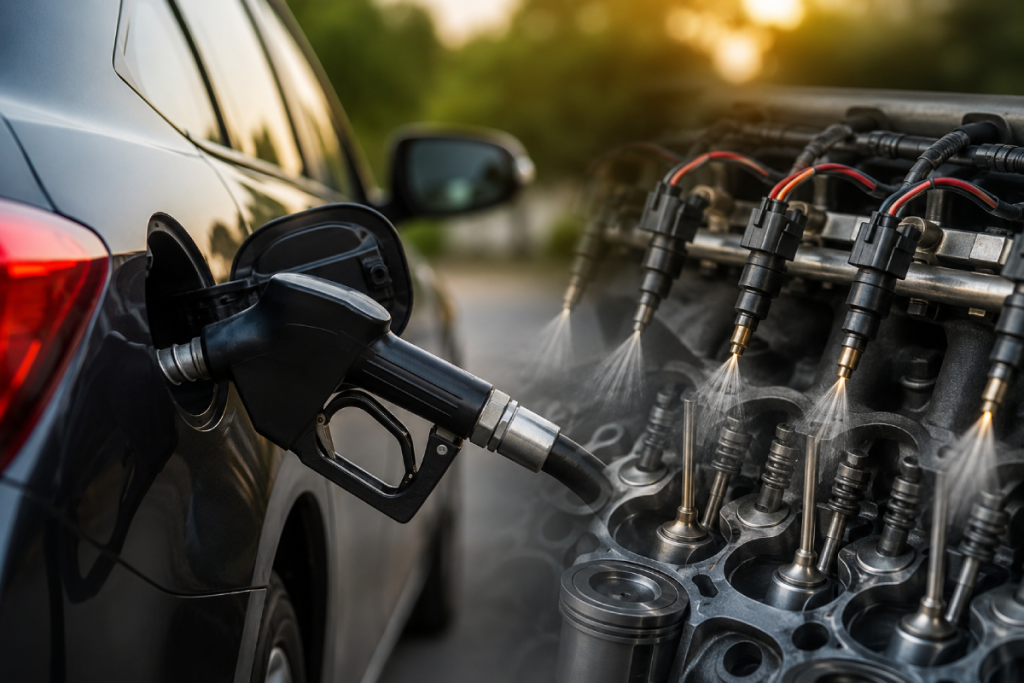
Your fuel injectors are responsible for delivering precise amounts of fuel into the engine.
Over time, deposits can build up inside the injectors, restricting fuel flow or causing uneven spray patterns. Carbon deposits may also accumulate on intake valves and combustion components.
When fuel delivery becomes inconsistent, combustion efficiency suffers. The engine may compensate by using additional fuel, reducing MPG, and overall performance.
Dirty Air Filters
When the engine air filter becomes clogged with dirt, dust, and debris, airflow can become restricted. This can negatively affect combustion and engine performance.
Although modern engine management systems can compensate for some airflow restrictions, a severely dirty air filter may still contribute to reduced fuel economy and diminished power.
Failing Spark Plugs
Spark plugs play a critical role in the combustion process.
Their job is to ignite the air-fuel mixture inside each cylinder. As spark plugs wear out, ignition becomes less efficient. Incomplete combustion can occur, causing fuel to be wasted rather than converted into usable power.
Bad Oxygen O2 Sensors
Oxygen sensors continuously monitor exhaust gases and provide feedback to the engine control module.
This information allows the computer to adjust fuel delivery for optimal performance and efficiency.
When an oxygen sensor begins to fail, the engine may receive inaccurate data. As a result, the fuel mixture can become excessively rich, causing the vehicle to burn more fuel than necessary.
A faulty O2 sensor is one of the more common causes of a sudden drop in fuel economy.
Tires and Aerodynamics
Under-Inflated Tires
Tire pressure has a direct impact on rolling resistance.
When tires are under-inflated, more of the tire’s surface contacts the road. This creates additional friction, forcing the engine to work harder to move the vehicle.
Even slightly low tire pressure can negatively affect fuel economy over time.
Bad Wheel Alignment
Wheel alignment problems can create resistance that reduces efficiency.
When wheels are not properly aligned, tires may drag slightly rather than rolling smoothly. This additional resistance increases the workload on the engine and accelerates tire wear.
Correcting alignment issues not only improves handling but can also help maximize your vehicle’s fuel efficiency.
Aerodynamic Drag
Air resistance becomes increasingly important as vehicle speed increases.
Roof racks, cargo carriers, oversized accessories, and even open windows at highway speeds can create additional aerodynamic drag.
As drag increases, the engine must generate more power to maintain speed, resulting in greater fuel consumption.
How to Improve Fuel Economy and Prevent Future Problems
If you’re looking for practical ways to improve fuel economy, focus on both driving habits and maintenance.
A few simple strategies include:
- Drive smoothly and avoid aggressive acceleration
- Reduce unnecessary idling
- Maintain proper tire pressure
- Remove excess vehicle weight
- Replace dirty air filters
- Stay current with spark plug maintenance
- Address warning lights promptly
- Schedule regular fuel system inspections
- Perform recommended fuel injector cleaning when necessary
- Correct alignment and tire issues quickly
These proactive steps help improve MPG while reducing stress on critical engine components.
Most importantly, don’t ignore changes in fuel consumption. A sudden drop in fuel economy is often one of the earliest indicators that something requires attention.
Restore Your MPG: Schedule a Professional Fuel System Diagnostic in Greeley, Colorado
At Bullet Automotive & Diesel, we help drivers throughout Greeley, Brighton, Fort Morgan, and the surrounding Colorado communities diagnose fuel economy concerns and restore vehicle performance.
Whether the issue involves clogged fuel injectors, carbon buildup, failing sensors, ignition problems, or another fuel system concern, our experienced technicians can provide an accurate diagnosis and dependable repairs.
We’re committed to honest service, quality workmanship, and helping drivers maximize their vehicle’s fuel efficiency for the long haul.
If your vehicle isn’t getting the MPG it used to, schedule a fuel system diagnostic with Bullet Automotive & Diesel today and let our team help get your vehicle performing its best again.
Contact us at 970-415-8018 or reach our Facebook page.


