

[rank_math_breadcrumb]
Your vehicle’s brakes are arguably the most crucial safety system on the road. When you press that pedal, you expect a reliable, firm response that slows or stops your car safely and quickly. But what happens when the feeling isn’t right? What if you hear a grinding noise or feel an unsettling shudder? Often, the culprit is a worn-out or damaged brake rotor.
For drivers in Greeley and Brighton, Colorado, and the surrounding area, understanding the symptoms of bad brake rotors isn’t just about saving money on premature repairs; it’s about keeping you safe on the road. The rotors, which are the large metal discs or drums that your brake pads clamp down on, are subject to immense heat and friction. Over time, they wear down and become less effective, compromising your stopping power.
At Bullet Automotive & Diesel, we’re not just about fixing cars; we’re here to change how you feel about auto repair. We fix cars and diesel vehicles, from Engine Repair and Diesel Mechanics to Oil Change and Brake Repair. Our team is passionate about delivering honest, reliable service with a personal touch. If you’re asking yourself, “when to replace brake rotors,” this comprehensive guide is for you. Knowing the brake rotor replacement signs will empower you to seek out professional help from brake repair specialists in Greeley before a minor issue becomes a major safety risk.
6 Key Warning Signs It’s Time to Replace Your Brake Rotors
Brake rotors are designed to be durable, but they are wear items—meaning they will eventually need to be replaced. Ignoring the early warning signs can lead to severe damage to your entire braking system, including the calipers and pads, resulting in a much more expensive repair down the road. Pay close attention to these six critical signs that indicate it’s time for a professional brake inspection and likely rotor replacement.
1. Unusual Squeaking or Squealing Sounds While Braking
While this noise is most often associated with worn brake pads, a high-pitched squeal can also be an early sign of a rotor problem.
- The Cause: Brake pads contain a small metal shim, often called a wear indicator. When the pad wears thin, this shim contacts the rotor, creating a loud, distinct squealing sound to alert you to replacement. However, if new pads were recently installed and the noise persists, it could be the pads’ material vibrating against a scored or uneven rotor face.
- The Fix: If new pads don’t solve the problem, a professional auto repair shop will need to examine the rotors. If the rotors have deep grooves or an uneven surface, they may need to be resurfaced (machined) or, more likely, completely replaced. Ignoring this can lead to a more severe grinding sound, which means the metal backing of the brake pad is grinding directly on the rotor, causing rapid and dangerous damage.
2. Vibration or Pulsation in the Brake Pedal or Steering Wheel
This is perhaps the most classic and unmistakable symptom that will tell you how to tell if brake rotors are bad. It often feels like a rapid, back-and-forth shuddering when you apply the brakes, especially at higher speeds.
- The Cause: This shaking is caused by rotor warping or severe uneven wear, a condition known as “lateral runout” or “thickness variation.” As the brake pad presses against the spinning rotor, an uneven surface causes the caliper piston to be rapidly pushed back and forth. This pulsation is transmitted through the brake fluid to the pedal and through the steering linkage to the wheel.
- The Danger: A warped rotor significantly reduces the brake pads’ contact area, greatly diminishing your braking power. It is a critical safety issue that needs immediate attention from brake repair specialists.
3. Increased Braking Distance: Taking Longer to Stop
If you notice that your car is taking longer to come to a complete stop than it used to, or if you have to press the brake pedal with significantly more force, your rotors may be at fault.
- The Cause: Severe rotor wear symptoms, such as deep scoring or warping, reduce the friction surface available for the brake pads. When less friction is generated, it requires more time and distance to stop the vehicle. This loss of efficiency is dangerous, particularly in emergency stopping situations.
- The Reality: An increase in stopping distance is a clear indicator that your entire braking system, including the rotors, has compromised performance. Don’t wait—this is a life-or-death scenario where an immediate visit to an auto repair shop like Bullet Automotive & Diesel is necessary.
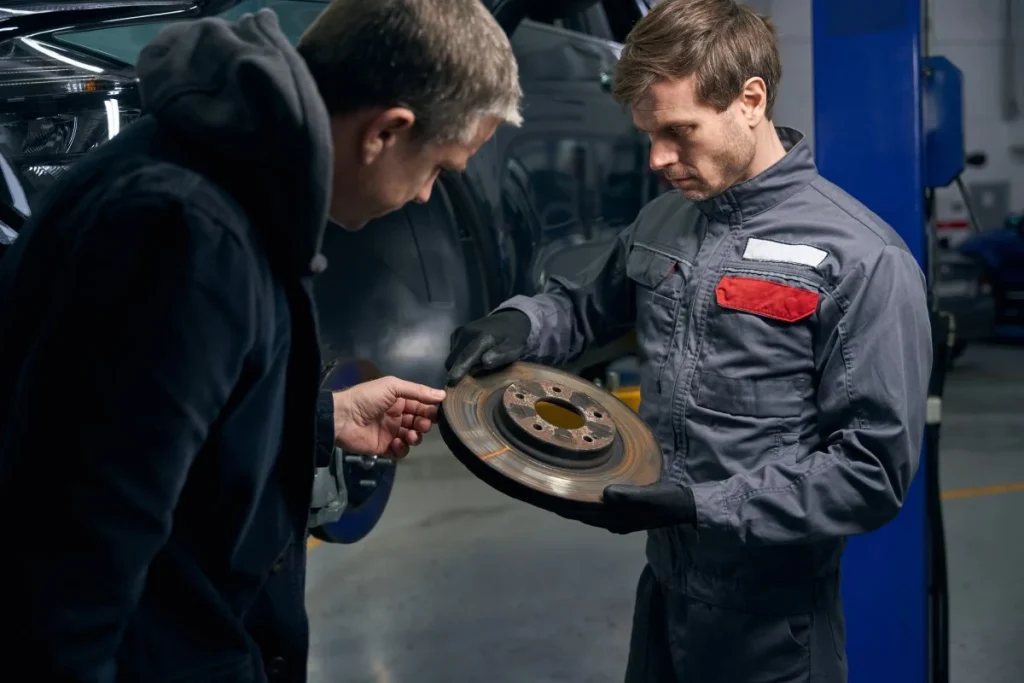
4. Visible Scoring, Cracks, or Grooves on the Rotor Face
A visual inspection of your rotors can often reveal significant wear without taking anything apart.
- The Cause: Scored rotors, which have noticeable grooves or deep circular scratches, are the result of worn-out brake pads being neglected until the metal backing plate starts grinding against the metal rotor. Cracks, which can be small surface hairline fissures or larger stress fractures, are a result of extreme heat and stress on the rotor metal.
- The Danger: Deep grooves prevent the new brake pad from achieving full contact, and they can accelerate the wear of new pads. Cracks are a serious failure point, as they can propagate and cause the rotor to break apart entirely, leading to total brake failure. A rotor with deep grooves or any sign of cracking is no longer safe and must be replaced immediately.
5. Blue Discoloration from Rotor Overheating
Brake rotors are typically a uniform silver or grey metal. A noticeable blue or purple tint is a sign of extreme stress and heat.
- The Cause: The discoloration, often called “hot spots” or heat checking, is a result of the rotor metal being heated past its intended operating temperature. This usually happens during hard braking, aggressive driving, or towing heavy loads. The heat permanently changes the metal’s structure, causing it to become harder in those areas.
- The Problem: The hardened blue areas are less efficient at dissipating heat and have an inconsistent friction surface. This difference in metal hardness creates an uneven grab when the brake pad contacts the rotor, which quickly leads to the shuddering/pulsation described in sign #2. Rotors with significant blue discoloration cannot be resurfaced and must be replaced.
6. A Shaky or Wobbly Feeling When Applying the Brakes
While similar to the pulsation in the pedal, a pronounced shaking that seems to come directly from the front end or steering column, especially during gentle braking, can be an indicator of severe damage.
- The Cause: This intense wobbling is often a result of extreme runout or a completely warped rotor that has a significant thickness variation. The rotor is essentially pushing the caliper and, consequently, the wheel hub assembly back and forth as it spins.
- The Action: If you experience this symptom, your car is severely compromised. Stop driving immediately and have your vehicle towed to a professional auto repair shop for a complete brake inspection by brake repair mechanics.
How Rotor Thickness Affects Brake Performance
When you visit Bullet Automotive & Diesel for brake service, our brake repair specialists use precision tools like a micrometer to measure the thickness of your rotor. This measurement is critical because, as the rotor is worn down by the brake pads, its ability to function safely decreases significantly.
Every manufacturer specifies a Minimum Thickness (often stamped right onto the rotor, indicated as MIN TH) that the rotor must maintain for safe operation. This limit is in place for several key reasons:
- Heat Dissipation: Thinner rotors have less mass, which means they can absorb less heat. When a rotor overheats, it can lead to “brake fade”—a dangerous condition where the brakes temporarily lose their effectiveness. The minimum thickness ensures there is enough metal to safely manage the heat generated by braking.
- Structural Integrity: Rotors are under extreme pressure when the brake caliper clamps down. If the rotor gets too thin, its structural integrity is compromised, making it susceptible to warping, cracking, or even catastrophic failure under hard braking conditions.
- Runout and Variation: A thin rotor is far more likely to develop runout (warping) and thickness variation—the root cause of that familiar brake pedal pulsation. Once a rotor wears past its minimum specification, it is almost guaranteed to cause performance issues.
If your rotors are even slightly below the minimum thickness, a professional mechanic will advise immediate replacement. Attempting to install new brake pads on a rotor that is too thin, or trying to resurface a rotor that is already close to the limit, is a dangerous practice that risks your safety and is not an option our team at Bullet Automotive & Diesel would ever consider. We prioritize your safety over cutting corners.
Top Driving Clues You Need New Rotors
While the mechanical signs are clear, sometimes the first indication of a problem is how your car feels on the road. The relationship between your driving style and your braking components is undeniable, and certain driving habits can accelerate the need for brake rotor replacement.
- You frequently brake hard or are a “two-footed” driver: Constant, heavy braking generates massive amounts of heat. If your driving routine involves a lot of quick stops—be it city driving in Greeley traffic or driving in congested areas of Brighton—you are putting your rotors under extreme thermal stress. This constant heat cycling is what leads to blue spots and warping.
- You drive a heavy-duty vehicle or tow often: Trucks and diesel vehicles, which we specialize in at Bullet Automotive & Diesel, place a much heavier load on the braking system. If you use your vehicle for towing trailers, boats, or heavy equipment, your brakes work overtime. The heavier the load, the more quickly the rotors will wear and the more susceptible they become to heat damage. Our Diesel Mechanics are specially trained to assess and replace heavy-duty braking components designed for maximum performance and safety.
- You have an inconsistent or “soft” brake pedal feel: A change in the pedal’s firmness can be a general symptom of several brake issues, but if it’s combined with a shudder or noise, it points directly to the rotors. A soft pedal can indicate excessive heat transfer into the brake fluid due to overly thin rotors, which can boil the fluid and cause a spongy, ineffective brake feel.
- Your rotors are significantly older than your brake pads: While brake pads should typically be replaced more often than rotors, some modern vehicles and specific driving conditions may require rotor replacement every time the pads are changed. A general rule of thumb is to check the thickness, but if you have gone through two sets of brake pads without replacing the rotors, it is highly recommended to inspect them closely. At a minimum, every brake pad replacement should include a thorough brake inspection by a certified mechanic to assess the condition and thickness of the rotors.
Understanding these clues and acting on them is paramount. Waiting until you feel that severe vibration or hear that metal-on-metal grinding could mean the difference between a routine, affordable brake service and an emergency repair—or worse, a collision.
Conclusion: Stay Safe with Timely Brake Rotor Replacement
Your car’s braking system is a complex, high-performance assembly, and the brake rotors are its unsung heroes. As you navigate the roads of Greeley and Brighton, Colorado, your confidence behind the wheel relies on your brakes working perfectly, every single time. Knowing how to tell if brake rotors are bad by recognizing the brake rotor replacement signs like squeaks, shakes, and visible wear is your first line of defense.
At Bullet Automotive & Diesel, we are your trusted brake repair specialists in Greeley and Brighton. We are an auto repair shop with a difference—committed to honest, reliable service with a personal touch. Whether you need a simple oil change, complex engine repair, or are looking for expert Diesel Mechanics to handle your heavy-duty truck, our team is equipped to handle it all.
Don’t ignore the warning signs. If you are experiencing any of the symptoms of bad brake rotors discussed here, or if it’s simply time for your routine brake inspection, call us today. We will provide a transparent, accurate assessment and perform the necessary repairs to get you back on the road safely and securely.
Ready to ensure your vehicle is stopping as safely as it should be? Would you like me to find the nearest Bullet Automotive & Diesel location in Greeley or Brighton, Colorado, so you can schedule a professional brake inspection?


